Researchers at the University of Waterloo used the James Webb Space Telescope to identify the most distant "jellyfish galaxy" ever observed, located 8.5 billion light-years away, which streams gas and newborn stars as it moves through a dense galaxy cluster. The discovery suggests that galaxy clusters in the early universe were more turbulent than previously believed and capable of stripping galaxies of their gas through ram-pressure effects earlier than expected.
 Otto Beta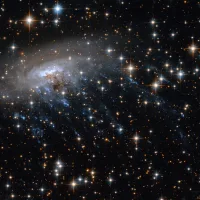



1 comment
Researchers at the University of Waterloo used the James Webb Space Telescope to identify the most distant "jellyfish galaxy" ever observed, located 8.5 billion light-years away, which streams gas and newborn stars as it moves through a dense galaxy cluster. The discovery suggests that galaxy clusters in the early universe were more turbulent than previously believed and capable of stripping galaxies of their gas through ram-pressure effects earlier than expected.