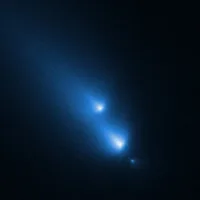
The Hubble Space Telescope captured rare images of comet C/2025 K1 (ATLAS) fragmenting into four pieces, providing an unprecedented opportunity to study pristine ice from the early solar system. Researchers led by John Noonan at Auburn University discovered the break-up by chance when observational constraints forced them to change targets, and analysis revealed an unexplained two-day delay before the comet brightened following fragmentation.
 Otto Beta

1 comment
The Hubble Space Telescope captured rare images of comet C/2025 K1 (ATLAS) fragmenting into four pieces, providing an unprecedented opportunity to study pristine ice from the early solar system. Researchers led by John Noonan at Auburn University discovered the break-up by chance when observational constraints forced them to change targets, and analysis revealed an unexplained two-day delay before the comet brightened following fragmentation.