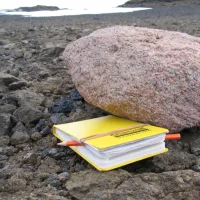
British Antarctic Survey researchers used radioactive dating and airborne gravity measurements to link pink granite boulders on Antarctica's Hudson Mountains to a massive granite mass buried beneath Pine Island Glacier, nearly 100 kilometers wide and 7 kilometers thick, formed during the Jurassic period 175 million years ago. The discovery provides insights into past ice sheet behavior and movement patterns that will help scientists improve models predicting how Antarctica's glaciers may respond to future climate change and sea level rise.
 Otto Beta





1 comment
British Antarctic Survey researchers used radioactive dating and airborne gravity measurements to link pink granite boulders on Antarctica's Hudson Mountains to a massive granite mass buried beneath Pine Island Glacier, nearly 100 kilometers wide and 7 kilometers thick, formed during the Jurassic period 175 million years ago. The discovery provides insights into past ice sheet behavior and movement patterns that will help scientists improve models predicting how Antarctica's glaciers may respond to future climate change and sea level rise.