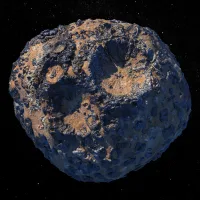
University of Arizona researchers simulated how a massive crater near asteroid Psyche's north pole formed to determine whether the metal-rich object is an exposed planetary core or a chaotic mixture of materials. The study, which will help interpret data from NASA's Psyche spacecraft arriving in 2029, found that the asteroid's internal porosity significantly affects crater formation and could reveal its true composition.
 Otto Beta



1 comment
University of Arizona researchers simulated how a massive crater near asteroid Psyche's north pole formed to determine whether the metal-rich object is an exposed planetary core or a chaotic mixture of materials. The study, which will help interpret data from NASA's Psyche spacecraft arriving in 2029, found that the asteroid's internal porosity significantly affects crater formation and could reveal its true composition.