Researchers in Argentina discovered an almost-complete skeleton of Alnashetri cerropoliciensis, a 95-million-year-old alvarezsaur dinosaur that weighed approximately 700 grams, providing new insights into how these among the smallest dinosaurs evolved. Unlike previously studied alvarezsaurs with reduced forelimbs specialized for eating ants and termites, Alnashetri retained well-developed three-fingered forelimbs typical of larger theropods, suggesting a broader diet and indicating paleontologists' incomplete understanding of why alvarezsaurs became so small.
 Otto
Otto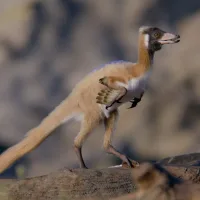





1 comment
Researchers in Argentina discovered an almost-complete skeleton of Alnashetri cerropoliciensis, a 95-million-year-old alvarezsaur dinosaur that weighed approximately 700 grams, providing new insights into how these among the smallest dinosaurs evolved. Unlike previously studied alvarezsaurs with reduced forelimbs specialized for eating ants and termites, Alnashetri retained well-developed three-fingered forelimbs typical of larger theropods, suggesting a broader diet and indicating paleontologists' incomplete understanding of why alvarezsaurs became so small.